Monday, September 10, 2012

Canapé Delights

A canapé is a small piece of delicately and beautifully prepared food that usually can be eaten in one bite. It's a little tedious but also quite enjoyable to make as the variations can be as endless as one's imagination.

For me the most easy route is to take some smoked salmon and slices of sour dough or baguette. A quick sprinkling of olive oil then rubbing the bread with fresh garlic before topping it with freshly diced red tomatoes, salmon and parmesan cheese already makes my mouth water. I set the toaster oven to medium-low so I could warm everything and melt the cheese nicely without drying and toasting the canapés.

Fruits can be used, too, but the cooking procedure would change. I'm yet to experiment on fruits.

The photo shows samples of beautiful and colorful canapés I had at a media event I attended sometime ago. We eat with out eyes, and a big plate of these canapés surely attracted my eyes and my palette as well.

Saturday, February 5, 2011

How to murder a cake


We gave a friend a chocolate cake for her birthday and we didn't just eat it, we had fun with it.

The cake came in a round yellow box with polka dots yellow ribbon. The cake is made to look like an emoticon, which is no surprise because it's from Makati Shangri-la's Emoti-Cake shop.

When cakes look this pretty, it's so hard to decide how to slice and eat it because it's hard to see a thing of beauty get ruined. But it must be eaten so there's really no way around it, or is there?

In our effort to "preserve" the emoticake's look, we gingerly took parts of the cake one piece at a time.


 First to go was the mouth, then the right eye, followed by the left eye.

When we finished, the cake looked like a torture victim and we felt like we were mean and crazy people.


We didn't mean to deface the good cake, we actually loved this cake. But we somehow turned it into something from Tim Burton's Corpse Bride movie.

Next time, we will just slice a cake like normal people do. :p

Saturday, January 29, 2011

Home-made pumpkin soup

There's a vegetable soup I've been religiously cooking and it satisfies me and the people I share it with. It's my home-made pumpkin soup. I'm sure I got the inspiration from Barefoot Contessa, but I've always simplified her ingredients and procedures until I come to my own comfortable, yet still delicious version.

Such is the case of my pumpkin soup. It's very simple. Here are the ingredients and the no-frills cooking method that can serve four to five people:

INGREDIENTS
- a quarter of pumpkin, a.k.a. calabasa, peeled and chopped into cubes
- a box of full cream milk
- a large onion (yellow or red)
- about 6 pieces of garlic
- chicken cube
- salt and pepper
- fresh basil leaves, at least two for every serving bowl

TO COOK
Boil the chopped pumpkin in fresh water until they are tender. When it boils, add the chicken cube, chopped onion and garlic and cook for another 2 minutes.

Why chicken cube? Because I don't always have chicken stock and the inevitable "debris" in chicken stock makes the final pumpkin soup looking kinda muddy.

After boiling, let everything to cool a bit before putting in a blender or osterizer in small batches. First puree the boiled pumpkin, then you may opt to liquify it for just a minute towards the end. Pour the pureed batch in a cooking pot and continue pureeing the rest.

When all is ready, return the pot to the stove and season the soup with salt and pepper. Minutes before it boils again, add the creamer and stir constantly and make sure to lower or turn off the heat before the boiling peaks again, otherwise, the cream tends to cluster and turn cloudy. Although stirring will make the cream blend in the soup well, I just think not letting it boil anew is better.

Pour in serving bowls and garnish with fresh basil leaves. Make sure to add the fresh basil when the person is really about to sip the soup, otherwise the leaves will turn black, wilt and cook. The flavor will be the same but it won't look as nice as in the picture. Enjoy!

Wednesday, November 10, 2010

Superior Singapore Chicken Rice by Wee Nam Kee

Mouth-watering Singapore Chicken Rice at Wee Nam Kee
One of my favorite dishes in the world is Singapore chicken rice. It's a national dish in the island state and I always try to enjoy a set meal that includes fragrant rice, soft chicken, and the condiments that go with it every time and I mean every time I find myself in Singapore.

I order it wherever and whenever the opportunity shows up that is why I have enjoyed this dish in different areas such as the Funan IT Mall food court, in different hawker stations, at restaurants in Boat Quay and Clarke Quay, in two branches of East Coast restaurant, at the food court of the Changi Airport, and in other hole-in-the-wall locations. That's how I love the dish. It helps, too, that it's usually a cheap but satisfying meal to have for lunch or dinner.
Cereal prawns

My last Singapore trip took me to a new haven of Chicken Rice. It was the famous restaurant Wee Nam Kee at Novena Ville in Thomson Road. It was simply the best.

I've never had chicken rice served family style, meaning in big quantity for sharing until I had the pleasure of dining at Wee Nam Kee with friends. The group I was with ordered one whole chicken and cups of rice and condiments for all. We didn't waste another minute when the complete chicken rice number was laid on our table. We engaged in some very serious fork and spoon maneuvering as we happily share the tender chicken swimming in shallow salty and sweet sauce. We downed mouthfuls of Wee Nam Kee's delicious chicken rice with cans of cold soya milk. It was a match made in heaven!
Mr. Wee during our interview with him after dinner

My next favorite meal in Singapore is prawn with cereals. Wee Nam Kee also serves it, and we also devoured a plate of it. I also love chili crab, but sometimes the hot chili overwhelms me.

Wee Nam Kee is opening a branch in Ayala Triangle and the night we ate there the owner was just days away from going to Manila himself for the restaurant opening. The owner, Mr. Wee Liang Lian is the third generation proprietor who now shoulders the management of the restaurant after his father and grandfather. He sat down with us and willingly answered my questions regarding his chicken rice enterprise and the soon-to-open branch in Makati.

He told us that his grandfather started the restaurant in 1989 and since then it never closed its doors to customers except during Chinese New Year. Happy to hear how we enjoyed his product, Mr. Wee or Junior, as he is called by family members, informed us that the sweetness in the chicken and its sauce comes naturally from the broth.

Feasting diners at Wee Nam Kee
"When you eat the cold chicken with the hot rice, it creates a different sensation in your mouth," he told us.

Wee Nam Kee is famous among locals and especially among Filipinos in Singapore. That night we were there, several tables were occupied by Filipinos who were obviously enjoying what they're eating. Wee Nam Kee is so famous that Mr. Wee said even Philippine presidents have been his customers.


Wee Nam Kee's busy store front
Former President Joseph Estrada at one time closed the entire restaurant with his police escorts to enjoy Mr. Wee's chicken rice. Former President Gloria Arroyo also turned to Wee Nam Kee during one of her state visits for individual packed chicken rice meals to feed 1,000 Filipina domestic helpers working in Singapore.

Mr. Wee said Philippine generals, celebrities and Philippine embassy guests and dignitaries often dine at his restaurant as well. They belong to the mob of customers who collectively eat an average of 150 to 180 chicken (rice) at Wee Nam Kee everyday. During weekends, Mr. Wee said they cook over 200 chicken (rice).

The Makati branch sent its chefs at Wee Nam Kee in Singapore to train for a month. Mr. Wee, on the other hand, sent here his own chef to also provide the training. He said he is not worried about sharing his recipes because it is a way for him to promote Singapore's national dish to the world.
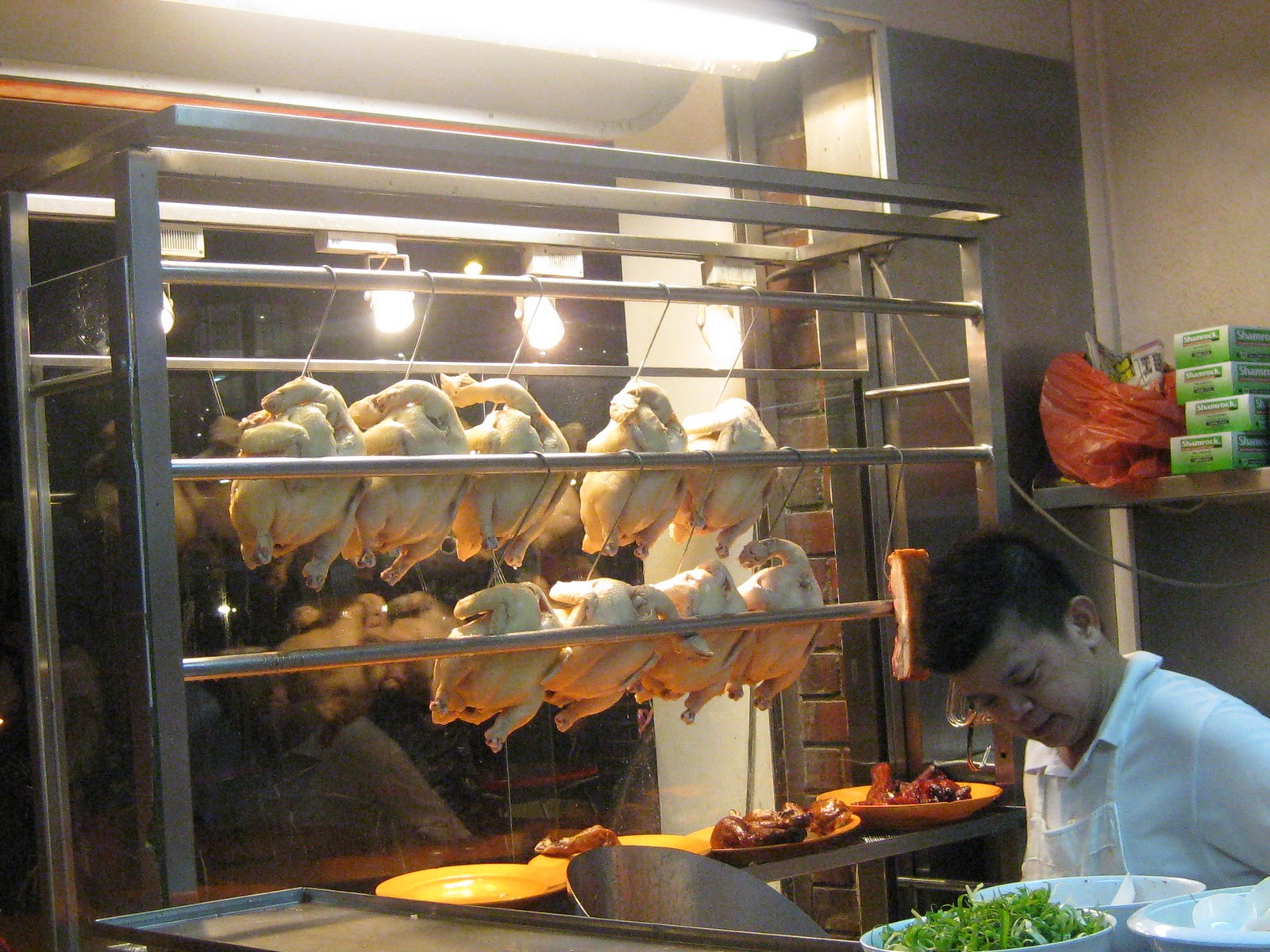
Tempting display of Wee Nam Kee's white chicken.

The Makati restaurant, being in the country's premium business location, will surely have a much more upgraded look than the one in Singapore which is a very unassuming restaurant. I remember us sitting next to carts of canned drinks as we ate. There were airconditioners but the place is wide open so we sweated a bit. In other words, forget ambience. What you won't forget, however, after eating at Wee Nam Kee is the perfectness of their chicken rice. I'm happy and excited that Wee Nam Kee is now here with us sans a plane ride.

Saturday, September 11, 2010

Refreshing Japanese salad

The Japanese restaurants that I frequent serve a refreshing cold salad called Kani. It's made of thinly sliced cucumber, mango, crab stick, fish roe, and Japanese mayo. If there's Kani in a buffet spread I take it as my appetizer and, if the mango is really sweet, as my dessert as well. It's so light and refreshing. It's really a good way to start and end a meal.

At home, I sometimes make my own version. I don't have access to fish roe (it's expensive and I don't know how to buy and serve it) so the quality is not the same, but it ain't bad either. Here's what I toss in a bowl:

INGREDIENTS:
- 1 medium cucumber
- 1 ripe Philippine mango
- 4 crab sticks
- 2 tbsps of mayonnaise
- salt and pepper

TO PREPARE
- Wash and roughly peel the cucumber. Remove the seed.
- Slice the cucumber thinly. Place the slices in a sieve and sprinkle some salt. Let it stand so the cucumber releases its water. The salt helps speed up this draining process.
- Slice the mango flesh as thinly as the cucumber
- Loosen the crab sticks until they are like thin noodles
- Put all three ingredients together in a bowl and add the mayonnaise
- Add a bit of pepper
- Put in fridge to cool before serving. Enjoy!

Tuesday, September 7, 2010

I'm a soup person

I'm a soup lover. I have a few acceptable recipes under my sleeves that I am not shy to serve to others who could appreciate or use a hearty soup to warm the soul. But the peeling, mixing, pureeing, blending and, of course, cooking, could be quite tiring that I sometimes find it simpler to open the cupboard and look for instant canned or boxed soups. Usually I buy Campbell soups and it's a brand that saw me through many rainy nights when a hot soup makes me cozy inside. But Campbell now has serious competition in my cupboard space. A trip to Healthy Options made me discover Pacific Natural Foods selection of all natural and organic soup.

Now I don't always have to do so much work to have a creamy tomato or squash soup when I want it. The company Pacific Foods of Oregon, Inc. does all the work that give me a happy tummy. My favorite is the Creamy Tomato Soup. It can serve two to three people for less than P130, I think. The company says their milk comes from a local dairy, their tomatoes ripen on the vine and there's a real coconut in the Cashew Carrot Ginger.

 Here are five of the Pacific Food creamy soups I've bought. Of course, nothing equals the pride a cook feels when a pot of soup she cooked gets praises, but taking the instant route with this brand is not bad at all because it's really satisfying, healthy and could even be more affordable.

Thursday, September 2, 2010

Vegitating


I'm a meat-lover, but I can eat my share of greens as well. Just recently, I happily noted the abundance of vegetables in my refrigerator. Here in the Philippines, we have a nursery rhyme about a little house with all kinds of vegetables in its garden. I felt I'm living in one when I saw the variety of vegetables I have. I temporarily took them out from the ref for a short photo opp. How lovely they look, I think, not to mention the vitamins and nutrients they have. My vegetable spread includes the following:
1. Spinach ( the leafy one at the leftmost side of the photo)
2. Baguio beans (still in its plastic bag)
3. Zucchini (partly hidden under the spinach)
4. Carrots
5. Eggplants
6. Cauliflower (with a barcode still on)
7. Leeks
8. Pechay Baguio (to the right of the cauliflower)
9. Sweet potato or camote
10. Singkamas (turnips or jicama)
11. Squash
12. Cucumbers
13. Yellow onion
14. Red onion
15. Tomato
16. Green bell pepper
17. Green lime
18. Long green chilis
19. Garlic
20. Celery
21. Potatoes
22. Black olives

Part of the stack is a bag of peanuts, but I'm not sure if it counts as vegetable. These items either played the lead or supporting role in the dishes I cooked later in the week. Because vegetables don't keep long, I feel pressured to cook them right away. I think keeping them in their plastic wrappers and moistening the tips of some help them stay fresh longer. Any effective tip on how to preserve vegetables in the ref longer?

Wednesday, August 25, 2010

Garlic Prawns

I love prawns cooked the simple way. My mother would just boil prawns in small amount of water with some salt and, presto, we have finger-licking lunch or dinner. Finger-licking because it's really not that enjoyable to not eat prawns with your hands, especially if it's as delicious as this garlic prawn dish I made recently.


INGREDIENTS:
- A kilo of tiger prawns, heads removed
- 2 tbsps of garlic powder
- half a box of butter
- salt and pepper

TO COOK:
- Slowly boil the prawns with salt and pepper in a deep pan
- Before the water completely evaporates, add the garlic powder and mix well to coat every prawn.
- Add in the butter and stir fry fast in medium heat.
- Serve immediately. Enjoy!

* Hopefully, you are not allergic to prawns because that would be a shame. I am allergic to certain types of shrimp though, like many other people.

Monday, August 23, 2010

Philippines' Farmers Market

I don't like going to wet markets. If I must, I have to be mentally prepared and suitably dressed for it because it's no small effort to step on slimy floors, to get bumped by "kargador" (porter, stevedore), to get nasal assault on every turn, to haggle for good price, to guard against pickpockets, to pay for goods in bills and coins, count your change, and to carry your own shopping bags. In fact, things get even more challenging if the one shopping is a blogger who must take photographs to chronicle an adventure. :) It also doesn't help that I have to have my mobile phone with me at all times and my parking ticket, too! I could probably think of a hundred reason why I'll avoid going to a wet market on most days, except when I need fresh seafood.

(Photos: public weighing scale, the seafood and meat sections, fruit vendors)


And seafood were exactly what I need one Sunday morning when I got dressed in simple shirt and jeans and drove to Farmers' Market. Here in the Philippines, this wet market is an institution. Located in Cubao, Quezon City, Farmers' Market has a good selection of seafood, meat, fruits and vegetables, and flowers, too. I go here mostly for the seafood. It's not the cheapest market to shop, but I think many come here for the quality and wide selection of seafood.

So, without further ado, here are the pictures I took during my recent trip at Farmers' Market. I took close-up pictures only from stores or vendors I patronized because I was afraid others would mind if I took photos without buying. I love the one of the mussels because there's a tabby cat at the foreground looking jaded towards all that the seas and ponds in the country came up with that morning.


(Above, fresh fish: Lapu-lapu are the rosy ones, and Pampano, I think, are the flat, silver ones.)


(Above, basins of prawns and shrimps in different sizes, next to a basket of live crabs tied up so they don't escape.)


(Above, baskets of kuhol or escargot. I don't eat snails, ty. The next stand sells mussels guarded by a shy young tabby.)


(Above, scallops that sell for P350 a kilo or about $8. Next photo shows clams for P60 or $1.50 and oysters and seaweeds.)

Thursday, August 19, 2010

Waffle Dogs

A quick snack that brings back childhood memories for me is wafffle dog. Every so often I feel like having one. Today is one of those days, so out came my yellow Kyowa waffle dog maker and after 15 minutes I have enough waffle dogs to last me till dinner time.

INGREDIENTS:
- a small box of waffle or hotcake mix
- an egg
- a teaspoon of cooking oil
- a cup of water
- 9 regular hotdogs (each cut in half)


TO COOK:
- follow the procedure on how to prepare the hotcake mix (read back of carton label)
- warm up the waffledog maker and one by one fill the molds with boiled hotdog and batter.
- close waffle dog maker lid and open only when it says it's ready (my Kyowa turns a green light on if the waffles are cooked)
- cook longer by half a minute if you want a darker brown waffle dog.
- serve with a cold drink. Enjoy!

Wednesday, August 11, 2010

Mussels in butter and garlic broth

Mussels, yum! I had my first chance to cook this shellfish recently. With some trepidation I tried to do it the way an Italian restaurant serves it. I must say my version came close because the mussels really tasted good as they swim in shallow butter and lemon sauce. I lovett!

INGREDIENTS:
- A kilo of mussels, cleaned and washed
- 3 cups of water
- 5 cloves of garlic sliced thinly
- a stalk of spring onion cut into small pieces
- 1 lemon
- 1/3 of a butter block
- salt and pepper
- half a cup of white wine
- half a teaspoon of sugar (optional if the wine is sweet)

TO COOK:
Boil the mussels with the garlic. When the shells start to open, add the wine, salt and pepper, sugar, and squeeze in the lemon. Drop the butter and spring onion last. Simmer for 5 minutes. Enjoy!

Friday, August 6, 2010

Cat cups and mugs

Let me deviate a little from blogging about 1 pot wonders to 1 cup wonders.

I love collecting cups and mugs with nice cat prints. It makes drinking coffee more fun for me. I have a small collection of cat cups and mugs and I will post pictures of each one in the days to come.

The cup in the photo is my latest find from a local store called Mobler that carries a selected number of Ikea products and other cool brands for the home. Please do tell and show me if you happen to own cute cat cups and mugs, too. They sure make perfect coffee-table chat points. :)

Tuesday, August 3, 2010

Cheese and mushroom omelette


I am a big breakfast person. I don't used to be. Not even when I was studying. I think it's because I didn't have time in the morning. That changed when I started working as a writer in a company that allowed me to start my day late. When I have extra time I enjoy cooking my own breakfast like cheese and mushroom omelette with garlic Spam and wheat bread on the side. Here's how I do it:

INGREDIENTS
- two beaten eggs
- one cheese singles (cheddar or anything milky)
- about a scoop of sliced button mushrooms (fresh or canned)
- cooking oil

TO COOK
Simply pour the beaten egg in a skillet with hot oil. Wait for the egg to brown underneath before carefully laying the cheese and mushroom on one side of the frying egg. Flip the egg halfway to make a pouch. Brown a bit more before serving.

You can fry the meat afterwards, toast the bread with some butter and always serve with a hot mug of freshly brewed coffee. Enjoy!

Sunday, August 1, 2010

My cook books

Who doesn't own a cook book, raise your hands?

I didn't own a cook book until my late '20s when my love for food and my palette started to get a little complex. I now have about 10 cook books, complemented by print-outs of recipes I find online, recipes printed on the back of canned good labels or food cartons that I keep, and post-its with my hasty handwriting of recipes I see on TV.


The first cook book I owned is called The Little Book of Fish & Seafood, which I now find odd that it's my first cook book because I'm a meat lover. I hardly use this book because some of the fish featured are not easily available like skate and herring.

Later somebody gave me the Practical Wok & Stir-Fry and the Practical Barbeque cook books. These two are right up my alley because most recipes were easy enough for newbie cooks to follow.

Discovering food and loving it unfortunately could make one put on weight. That must be the reason why someone gave me a Low Carb cook book, which I love because most recipes are well thought of, delicious but not too involved to prepare.

Another step-by-step cook book I have is called Meat Dishes from the Essential Cooking Series. This is also a friendly cook book that I consult from time to time.

I'm also a proud owner of three books by Ina Garten. I have the Barefoot Contessa At Home, Barefoot in Paris, and Barefoot Contessa Family Style. I love watching Ina Garten cook in her lovely home at the East Hampton. She is very generous with the ingredients and her environment -- her own herb and flower garden, the small food shops she frequent, etc. -- is something I wish to have or visit. I have attempted to replicate a number of her dishes already. Several of her ingredients, however, are unique to the U.S. so I have to make adjustments to recreate her recipes. I noticed, though, that she loves to use flour and butter a lot. She's also a heavy user of the food processor. Nothing wrong with these, really, and her dishes are great. But sometimes I do struggle with some of the "big production" recipes that seem so easy to follow when I'm just watching her do them. I also wonder who keeps her kitchen looking so pristine before, during and even after her cooking episode. Because mine certainly looks like where a bomb dropped after I finished cooking.

Last Christmas I acquired the two volumes of Julia Child's Mastering the Art of French Cooking. I am that intrepid! But that lasted only a few minutes before real trepidation set in because the moment I leafed through the pages (and saw the old-style reference drawings which I like but also kinda wish there are updated color photos of the dishes) of Julia Child's masterpieces, I felt so foolish to even think about replicating what a kitchen goddess had done.

I think 10 cook books will serve me for sometime when the mood to cook something new hits me. I just took them out from the shelves today and studiously listed and typed down the ones I think I'll try cooking in the days to come. Wish me luck :)

Tuesday, June 8, 2010

Beef shank with vegetables

Here's a beef shank dish that I've managed to cook on several occasions already. It's a simple meat-and-potato kind of dish but with a little extra garden variety and I make it extra tomatoey.


INGREDIENTS
- 1 kilo of beef shank, cut to serving size
- 1 can or a small pack of tomato sauce
- 8 small potatoes (peeled)
- 2 big carrots (peeled and cut)
- 2 large onions (sliced)
- 1 yellow capsicum (sliced)
- few olives
- garlic (crushed)
- a cup of red wine
- a tbsp of white sugar
- a dash of oregano
- wombok leaves
- salt and pepper


TO COOK:
Boil the beef shank till it's tender. Add the tomato sauce,potato, carrots, onion and garlic and continue boiling. Before the vegetables are done, add the wine, sugar and all the seasoning like salt, pepper and oregano. After it simmered for about 15 minutes, add the wombok leaves and the capsicum. Always sample the sauce to suit your taste. You can add some Knorr seasoning for more flavoring. Enjoy!

Monday, June 7, 2010

Siomai soup

There was one particular evening recently when I just couldn't call it a night because my stomach was still growling. I had dinner, yes, but it was so forgettable and unsatisfying that I wanted to eat again. Problem was I couldn't think what my extra dinner would be. I didn't want anything heavy and with carbs. Thankfully, there was an angel in my kitchen that night who quickly whipped up something for me.

The tasty invention involved the following...

INGREDIENTS:
6 large pre-cooked pork siomai dumplings (pre-cooked)
1 chicken broth cube
2 to 3 glasses of water
salt and pepper
1 tbsp of Lee Kum Kee soy sauce
2 medium sized eggs

TO COOK:
- beat the eggs and fry in vegetable oil. Once cooked, slice the egg thinly like noodles. Set aside.
- boil the water in a pot and add the dumplings and chicken broth cube.
- season with salt and pepper and soy sauce
- add the sliced egg

Enjoy!

Wednesday, June 2, 2010

Chicken Tortilla ala Shawarma

I wanted something quick but delicious for lunch that won't involve a lot of cooking. My solution was to fix some chicken tortillas which use the simplest ingredients and methods of preparation.


INGREDIENTS:
- 3 chicken quarters
- 4 medium-size tomatoes
- 1 big yellow onion
- 3 spring onions
- a teaspoon of garlic powder
- half a lemon
- a cup of mayonnaise
- a pack of tortillas
- olive oil
- salt and pepper

TO COOK:
- First, boil the chicken quarters in some salt and pepper.
- While it's boiling, slice the onion and tomatoes into small cubes. Chop the spring onions coarsely. Set aside in a dish or bowl.
- Put garlic powder and mayonnaise, plus olive oil and a dash of salt and pepper in a mixing bowl.
- Whisk everything together until the mayonnaise turns light.
- In a separate bowl, shred the boiled chicken meat or slice them thinly for a more uniform look.
- Squeeze some lemon juice to the chicken then give it a toss to distribute the lemon juice well.
- Heat the grill and place the tortillas. Heating the tortillas should just be for half a minute tops or else they could become crispy and crumbly, if not burned.
- Place the heated tortilla in a dish and lather it with some mayo-garlic spread. Put onion and tomatoes and shredded chicken on top of each other. Roll the tortilla and, if necessary, use a toothpick to hold it together.
- Enjoy!!


I think it would also be okay, if not great, to add some cheese but it's just the cheese monster in me talking. This dish is also a perfect snack item and a very quick one to prepare for guests who come unannounced.

How original is this dish or how different is it from shawarma? Well, it's original in the sense that I freely dabbled on the ingredients which I thought would work well together and only used my fleeting memory of a good shawarma I had long ago as reference. And, yes, instead of just one pot, I also used a griller. The result is a tasty meal to quell hungry pangs right away.

Tuesday, May 18, 2010

Menudo


Ahh...Menudo. A staple in Filipino feasts, menudo is also often served at home and in carinderias (informal food stands) and in office or school canteens. However, it's not something I always see in the menus of local restaurants. It's one of my favorite local dishes though it sure doesn't sound local; more like Spanish where the word "menudo" means small or little. And that's apparently how this dish, which is made up mainly of small cubes of pork and pork liver, got its name. Whatever its true origin is, I'm just glad I could cook a simple version of this Spanish-Filipino dish all in one pot.

INGREDIENTS:
* A kilo of pork kasim chopped into small cubes
* Half a kilo of pork liver, also chopped into small cubes
* Two medium sized potatoes, cut into small cubes
* One big carrot, cut into small cubes
* A big red onion and about 4 pcs of garlic chopped coarsely
* A small box of raisins
* A dozen of pitted olives
* Three cups of tomato sauce
* A teaspoon of sugar (optional)
* Soy sauce, salt and pepper to taste
* A bay leaf

TO COOK:
* Saute garlic and onion
* Add pork and a glass of water. Boil briefly.
* Add carrots, potato and tomato sauce. Also add the salt, pepper, soy sauce and bay leaf.
* Simmer for like 10 minutes before adding the chopped liver.
* Simmer some more till the liver is cooked before adding the raisins and olives.
* If it's a bit sour to the taste due to the tomato sauce, balance it with a teaspoon of sugar.
* Enjoy with hot rice.

Monday, May 17, 2010

Filipino Chicken & Pork Adobo

I am fascinated at how Adobo has become one of the things that defines us as Filipinos. I am told that there are many ways and variations to cook Adobo, although I only know one version, which is pretty basic but nonetheless delicious.

Foreigners, mostly Americans who have Filipino friends or married to a Filipino, love our Adobo. In my last US visit, a black taxi driver who was taking me to the Houston airport told me how he loved eating adobo with his Filipino friends. At first, he couldn't remember what it was called so I asked him to describe it. He had only so far mentioned soy sauce and meat when I blurted out "Adobo!", and he said "Yeah, that's the one!" and I think he kinda licked his lips at the memory of the last savory adobo dish he had.

I also spotted in a food court in one of the hotels in Las Vegas a Mexican food stand offering Chicken Adobo. I already bought my greasy, tasteless, starchy Chinese meal then so I passed on the Mexican Chicken Adobo; something I regret till now because I haven't stopped wondering how different or similar could it be from ours.

I was watching a reality TV last night called "The Family Restaurant" when the matriarch named Amy, a Chinese woman who is so jovial and friendly, declared she wants to offer Adobo in her "Amy's Chicken" food stand. She and her family are based in Canada where they operate a restaurant called Lingnam.

I loved Adobo even as a kid. I've eaten it so many times that when I had to cook one for the first time, I didn't need a recipe. It also helps that my family turned me into a sous chef (a fancy name for kitchen runner and helper) so I grew familiar with what ingredients are needed for Adobo.

On the off chance that there's still a grown-up Pinoy who doesn't know how to cook Adobo, let me share here my basic recipe for this timeless Pinoy dish.


CHICKEN PORK ADOBO (serves four)
* half a kilo of chicken thighs (cut in serving size)
* half a kilo of pork cubes with some fat
* 8 cloves of garlic (the more, the better)
* 1 big red onion
* half a cup of good soy sauce
* 5 tbsps of good vinegar
* 2 bay leaves
* peppercorns
* 3 teaspoons of sugar
* 2 tbsps of cooking oil
* 4 boiled eggs

TO COOK:
* In a tbsp. of cooking oil briefly fry the chicken and pork cubes just to brown them a bit. Set aside.
* Saute the chopped garlic and onion using another tbsp of cooking oil before adding all meat back in the pan.
* Pour the soy sauce and vinegar and let it boil.
* When it's boiling, add the bay leaf, peppercorns and sugar.
* Set the stove to medium heat and let the dish to cook until the pork and chicken are tender.
* Serve with boiled eggs on top.

**The quantity of soy sauce and vinegar, as well as the onion and garlic, peppercorn and sugar can be adjusted to suit individual tastes and preferences. I, for one, hate being constricted to super strict measurements when it comes to cooking...

When I was a young girl I would watch my mother cook Adobo and she would often caution me from stirring the pot after she had poured the vinegar in. She said the vinegar wouldn't cook properly if it's disturbed before it boils. But the ever impatient me couldn't resist stirring the pot when I cook Adobo now because I want to constantly taste the sauce to be sure the flavor is okay.

One time my sister made her version of Adobo using just salt instead of soy sauce. She called it "Adobong Puti" because the finished product naturally didn't produce the dark color from soy sauce. It also didn't produce the kind of Adobo taste I know, but I must say her Adobong Puti was not bad at all.

Then my other sister decided to really push the Adobo envelope after seeing a cooking show on TV that used catsup (!) to cook Adobo. It was bad, please don't try it at home.

As I said there are supposed to be many versions of Pinoy Adobo. Some add coconut milk. But this basic recipe I shared here already satisfies me and the people I serve it to, whose only usual complaint is that it makes them eat more rice.

Oh, I'm sure many Filipinos also know that leftover Adobo tastes even better, especially when the sauce has turned into gel. A true gastronomic dish that made Filipino Chicken & Pork Adobo a true classic.

Saturday, April 10, 2010

Chicken Patis

That's right, chicken Patis, not chicken pate.

I got this method of cooking chicken the simplest way from my mom. Her version was to boil choice cuts of chicken in small amount of water and fish sauce (patis) plus some slices of garlic and ground pepper. It's her way of flavoring the chicken in preparation for frying. It's the tastiest fried chicken version we cook at home!

But frying scares me because of the high possibility of oil splatters. So, one day, I discovered that if I boil the chicken through it's already a good dish as it is. Served with some steamed leafy vegetables on the side and my version of chicken patis comes close to the flavor of Singapore's famous Hainanese chicken, only saltier. The broth also turns into a gel when it cools down which can be used to sauce the hot rice. It can still be fried, but I now prefer to stop the cooking at this stage and just enjoy it right away.

To make chicken patis for two, you'll need:
* At least 6 to 8 pieces of chicken thighs or legs.* A teaspoon of sliced garlic
* Water to half cover the pieces of chicken in a pot
* About 6 to 8 tbsps of patis
* A dash or two of ground pepper
* One bay leaf


To cook:
* Put all the chicken pieces in one pot and half cover them in water.
* When it's boiling, scoop out the murkish film on the water surface. I think it's blood from the chicken.
* Add patis, garlic, ground pepper and bay leaf. Turn the stove to medium.
* Boil until chicken is tender. Check also that the broth is a little salty than what you usually take. Allowing the chicken to boil slowly on patis allows the meat to absorb the patis flavor. Do not let the broth to completely dry out.
* Steam some pechay or cut some cucumber and tomato as sidings.
* Best eaten with a hot plate of rice.